Showing posts with label Minnesota Twins. Show all posts
Wednesday, January 17, 2018
no. 744 - chuck manuel
Who is the man: Chuck Manuel's playing time dipped a bit in his second year in the majors. He appeared in 59 games for the Twins in 1970 and also played some of the year in the minors in Evansville, Ill.
Can ya dig it: Batting cage fun! But the catcher in the background kind of gives away that Manuel is actually outside the batting cage.
Right on: I just love cards of players who are better known as managers. It's even better when they have a different first name than they did as a manager.
You see that cat Manuel is a bad mother: Chuck/Charlie Manuel led the Phillies to back-to-back World Series appearances in 2008 and 2009 and to the Series title in 2008.
Shut your mouth: Manuel's father committed suicide in 1963. In a suicide note, he asked that Manuel take care of his mother and siblings. Manuel, who had a scholarship to play basketball for the University of Pennsylvania, instead took the Twins' offer of $30,000 to play baseball.
No one understands him but his woman: Manuel played six years in Japan and won the league's MVP award in 1979. Manuel learned how to speak Japanese, which helped him during his managing career.
(A word about the back): I'm assuming the record Manuel and Allison tied was most pinch-hit home runs hit by one team in one game. The Cardinals broke the record for pinch-hit home runs in a game in 2016 with three.
Wednesday, November 15, 2017
no. 724 - tom tischinski
Who is the man: Tom Tischinski appeared in 24 games for the Twins in 1970. He came to the plate 56 times, just like he did in 1969.
Can ya dig it: It's rather odd how Tischinski is sitting all the way to the right of the card. It makes me wonder what is to the right side of Tischinski that Topps didn't want in the photo.
Right on: Tischinski appears on just two Topps cards, 1970 and 1971. He is squatting in each one. He is A Catcher.
You see that cat Tischinski is a bad mother: Tischinski played just 82 games in his big league career so facts are few and far between. But I did find a photo of him attempting to upend Tony La Russa at second base when both were in the minor leagues.
Shut your mouth: Tischinski left a bit of an odd reply to an autograph request once.
No one understands him but his woman: Tischinski holds the Twins record for going the longest from the start of his career without recording an extra base hit. He went 90 at-bats over 1969 and 1970 managing nothing but singles.
(A word about the back): You can see the dismal batting averages. Tischinski never made it to .200 during his major league career.
Wednesday, August 23, 2017
no. 694 - rick renick
Who is the man: Rick Renick appeared in a career-high 81 games for the Twins in 1970 and set career highs in several categories.
Can ya dig it: Renick is displaying the yellow-bordered "Minnie and Paul" logo that the Twins have worn on their sleeves from the start.
Right on: I dig the distant American flag.
You see that cat Renick is a bad mother: Renick hit a home run off of the Tigers' Mickey Lolich in his first major league at-bat in 1968.
Shut your mouth: Renick managed in the minor leagues during the 1990s, most notably with the White Sox. One of his pitchers was Jason Bere, a brief sensation for the White Sox around 1993. Bere was cruising during one minor league start when Renick came out to remove him from the game. "Did you think you could have gone another inning," Renick asked Bere. "Yes," Bere said. "Do you think you can go another inning Thursday in Kansas City?" Renick replied. Bere looked at him. "Congratulations. You're in the major leagues," Renick said.
No one understands him but his woman: When Tom Kelly was named the Twins' manager before the 1987 season, Renick replaced Kelly as the Minnesota third base coach.
(A word about the back): You can tell by the 179 at-bats in 81 games that Renick pinch-hit a lot. His pinch-grand slam in that June 30th game turned a 5-2 Royals lead in the sixth inning into a 6-5 Twins lead (the Royals actually led 5-1 when the inning started but Harmon Killebrew led off with a solo homer).
Thursday, June 29, 2017
no. 675 - dave boswell
Who is the man: Dave Boswell struggled with what proved to be a career-ending arm injury during the 1970 season. He went on the disabled list for good in August of that year, sporting a 6.39 ERA.
Can ya dig it: Boswell had been released by the Twins in April 1971, signed by the Tigers, let go by the Tigers and then signed by Orioles in May. None of that is reflected in this card. Perhaps March was the limit for airbrushing a player into his new duds for the last series.
Right on: This is his final Topps card.
You see that cat Boswell is a bad mother: Boswell won 20 games for the AL West champion Twins in 1969. He was known for being a no-nonsense, fearless hurler, although on the temperamental side.
Shut your mouth: Boswell's most famous moment is his fight with his own manager Billy Martin. Boswell supposedly got into an argument with pitching coach Art Fowler at a bar during the '69 season. Teammate Bobby Allison took a heated Boswell outside and ended up getting clocked by Boswell. Martin then came out of the bar and wailed on Boswell, knocking him out.
No one understands him but his woman: Boswell suffered his arm injury during the 1969 ALCS, throwing a slider to the Orioles' Frank Robinson in the 10th inning of Game 2. Boswell kept pitching though and was ineffective the rest of his career, which ended prematurely in 1972 at the age of 26.
(A word about the back): Regarding the 173 strikeouts in 1964, Boswell was a prodigy in high school and tore up the minor leagues. He was once referred to as the American League's answer to Sandy Koufax.
Tuesday, March 14, 2017
no. 638 - stan williams
Who is the man: Stan Williams enjoyed his best season as a relief pitcher -- and possibly as any kind of pitcher -- in 1970. In his 12th season, he set career bests in appearances, earned-run average, winning percentage and a few other newer stats (not known in 1970), like ERA+, WHIP and SO/W.
Can ya dig it: Another photo in Yankee Stadium. I should have counted them all up from the beginning.
Right on: Williams was one year from what I consider his greatest card: his 1972 Topps night card.
You see that cat Williams is a bad mother: Williams was threatening on the mound (he's listed on the back of this card as 6-4 and 225) with a high, blazing fastball. On a Dodger rotation with a roll call of intimidating pitchers, Williams reportedly kept a "list" of batters he wanted to intimidate.
Shut your mouth: Williams had two nicknames. One was "Big Daddy". The other was a nickname that most people associate with a White Sox hitter, the "Big Hurt". Williams was called that because he wasn't afraid to hit batters.
No one understands him but his woman: The game that Williams is most noted for -- the third game of the 1962 playoff series between the Dodgers and the Giants -- contained one of the most second-guessed managerial moves in L.A. history. With the Dodgers ahead by a run with one out but the bases loaded with Giants, the right-handed Orlando Cepeda came to the plate. Walter Alston came to the mound and replaced Ed Roebuck not with lefties Larry Sherry or Ron Perranoski, but with the righty Williams, who was known to be wild. Said Dodgers coach Leo Durocher to catcher John Roseboro, "He'll walk the ballpark." Williams gave up a game-tying sacrifice fly, threw a wild pitch, was ordered to walk batter Ed Bailey to load the bases, then walked Jim Davenport to force in the go-ahead run.
(A word about the back): Williams was an All-Star in 1960, but he didn't play.
Thursday, December 15, 2016
no. 607 - paul ratliff
Who is the man: Paul Ratliff enjoyed the most playing time he received in any of his four major league seasons in 1970. He appeared in 69 games in his first stay in the majors since 1963.
Can ya dig it: This is Ratliff's only solo card. He appears on a four-player rookie card in the 1963 Topps set and a two-player rookie card seven years later (ouch) in the 1970 set.
Right on: Not a bad card for your only card.
You see that cat Ratliff is a bad mother: It's a stretch, but Ratliff was hit by a pitch seven times in 1970 (in just 149 at-bats), which was good for 10th in the American League that year. Had to be a tough guy to do that, right?
Shut your mouth: Ratliff is remembered for a bit of a bonehead play during a game against the Tigers. Pitcher Earl Wilson struck out for the final out of the inning, but Ratliff trapped the pitch, requiring him to either tag Wilson or throw to first. Instead, Ratliff rolled the ball to the pitcher's mound and walked off the field. Wilson proceeded to sprint around the bases, getting all the way past third, before the Twins retrieved the ball and caught Wilson in a rundown between third and home.
No one understands him but his woman: Ratliff, who was traded to the Brewers in the middle of the 1971 season, actually appears on another card, although his photo is credited to someone else, Ellie Rodriguez.
(A word about the back): Ratliff's biggest thrill came during the Twins' 10th game of the 1963 season on April 20. The two-run single only brought the Twins within 10-7 of the White Sox, who entered the ninth with a 10-4 lead. So it's not quite as exciting as it was written.
Monday, October 17, 2016
no. 586 - dick woodson
Who is the man: Dick Woodson spent most of 1970 with the Twins as a reliever. The rest of the year he was with Double A Evansville.
Can ya dig it: Poor Dick is working while everyone else just stands around.
Right on: "Dick Woodson" is one of the great baseball names on par with Pete LaCock and Rusty Kuntz. In fact, I'd be so bold to say that I think Woodson's name is only surpassed by former auto racer Dick Trickle.
You see that cat Woodson is a bad mother: Woodson was second on the 1972 Twins pitching staff in victories (14), games (36), innings pitched (251.2) and strikeouts (150).
Shut your mouth: During a game early in the 1969 season, Woodson gave up two home runs to Reggie Jackson. On the next at-bat, Woodson knocked Jackson down twice. Jackson responded by charging the mound and barreling over Woodson.
No one understands him but his woman: Woodson was selected by Players Union head Marvin Miller for the first salary arbitration case in 1974. Woodson was making $23,000 for the Twins and asked for $30,000. He was awarded the $30,000, causing Twins owner Calvin Griffith to moan, "This is going to kill us."
(A word about the back): I believe I've mentioned this before: the phrasing "possessed with an excellent fastball" is both odd and wonderful. An excellent fastball "possesses" him.
Thursday, August 25, 2016
no. 568 - sal campisi
Who is the man: Sal Campisi came over to the Twins from the Cardinals in a trade in late October 1970. He pitched in 37 games for St. Louis in 1970, all in relief.
Can ya dig it: I could've sworn Campisi was an outfielder. I know I should have looked at the bright yellow letters that say "pitcher," but the photo isn't exactly helping me out here.
Right on: This is Campisi's only solo card. He appears on a three-player rookie stars card in the 1970 Topps set.
You see that cat Campisi is a bad mother: Campisi led the Dominican Winter League in earned run average during the 1969-70 offseason with a 0.74.
Shut your mouth: Campisi apparently gained a reputation for eating too much when he was in the minor leagues. This article says it stemmed from when Warren Spahn was coaching him. Campisi had lost 12 pounds but then gained a few pounds back and Spahn talked to him about it. Campisi told him, "Do you want a fat winner or a skinny loser?"
No one understands him but his woman: Campisi won the first American Association Most Valuable Player award for pitchers in 1969 while playing for Tulsa. Later pitchers to win the award included Jim Kern, Bryn Smith, Jay Howell, Pascual Perez and Rick Helling.
(A word about the back): That airbrushed Twins logo looks far too big for that cap.
Wednesday, July 6, 2016
no. 550 - harmon killebrew
Who is the man: Harmon Killebrew was coming of his eighth-and-final 40-home run season when this card was issued. A year removed from his MVP season, he remained a feared slugger.
Can ya dig it: Killebrew appears to be in the depths of the batting cage here. Good shot.
Right on: Nice acting by Harmon. By the expression on his face, he seems to be admiring a titan blast.
You see that cat Killebrew is a bad mother: When Killebrew retired, he was fifth all-time in career home runs with 573. (He's currently 12th). Oh, and his nickname was "Killer".
Shut your mouth: David Letterman once dedicated an entire episode of his show on NBC to Harmon Killebrew. The Late Show had decided to host a Holiday Film Festival and asked various celebrities to create films that could be aired on the show. Letterman grew up a fan of Killebrew and asked him to make a movie. Killebrew didn't want to, but Letterman prodded him until Killebrew did. When the show aired, they ran out of time to air Killebrew's film. Letterman felt bad about that and decided to devote an entire separate show to Killebrew.
No one understands him but his woman: Killebrew was married twice. He had nine children.
(A word about the back): Killebrew is now sixth all-time in home run frequency. The top 10 is: Mark McGwire, Babe Ruth, Barry Bonds, Jim Thome, Ralph Kiner, Killebrew, Giancarlo Stanton, Sammy Sosa, Ted Williams and Manny Ramirez.
Thursday, May 12, 2016
no. 532 - bill rigney
Who is the man: Bill Rigney was entering his second season as manager of the Twins when this card was issued. He led the Twins to the AL West title in 1970.
Can ya dig it: Rigney is featuring the tell-tale leather neck of old-timey managers.
Right on: Rigney's card is 10 cards after the Twins team card. That might be the shortest number of cards between team card and manager in the set. (Yes, I think of stuff like this).
You see that cat Rigney is a bad mother: Rigney took the second-year Angels to a third-place finish in the American League in 1962, behind only the Yankees and Twins. The Angels were in first place on Sept. 12 and Rigney was named AL Manager of the Year after the season.
Shut your mouth: Rigney has one of my favorite quotes about modern ballplayers who think they have all the answers: "They really don't want to know. All they say is, 'hey man, that was 40 years ago. Things are different now.' Oh really? How different? Do they run to third base instead of first? Come on."
No one understands him but his woman: Rigney was both the first manager of the L.A. Angels and the first manager of an MLB team in San Francisco.
(A word about the back): When Rigney started his managerial career with Minneapolis, he also played several games for the team in 1954 and 1955.
Wednesday, April 13, 2016
no. 522 - twins
Who is the man: The Minnesota Twins experienced a season of deja vu in 1970. They won the American League West, just as they did in 1969. And they were swept 3-game-to-none by the Orioles in the ALCS, just as they were in 1969.
Can ya dig it: I am still so used to the Metrodome and the Twins playing on artificial grass that I find it odd to see the Twins among actual green grass, whether it's Metropolitan Stadium or Target Field.
Right on: The Twins don't have a lot of non-uniform people posing in the photo like some of the team shots in this set. It looks like there are a couple of clubhouse/trainer sorts at the far right of the second row and that's it.
You see that cat Rigney is a bad mother: Bill Rigney was entering his second season with the Twins after taking over in 1970 for the fired Billy Martin. The team shot is a bit far off and not in focus, but I believe the silver-haired Rigney is the sixth person from the left in the front row.
Shut your mouth: Rigney has his own card just 10 cards away. So I can't write about him anymore here. Don't want to use up material!
No one understands him but his woman: It's much too blurry to ID players. But someone who knows the Twins of this period better than I would have a chance at citing some of them. I think the guy on the far left in the front row is Cesar Tovar but it could just as easily be someone else.
Thursday, February 11, 2016
no. 500 - jim perry
Who is the man: Jim Perry was heading into 1971 as the reigning AL Cy Young Award winner and coming off back-to-back 20-win seasons.
Can ya dig it: I hope you can tell he's Gaylord Perry's brother from this photo.
Right on: It took me so long to know who Jim Perry is. I'd say that he might be one of the more forgotten players to have received a double-zero card number (for those times when Topps was specifically awarding double-zero numbers for star players, anyway).
You see that cat Perry is a bad mother: Perry is part of the second-winningest brother combination in big-league history. Jim and Gaylord won 529 games, 10 fewer than Phil and Joe Niekro.
Shut your mouth: Early in his major league career, Perry took a job in the offseason selling bomb shelters. Perry, who tended to give up the home run ball, said, "I ought to get one for myself."
No one understands him but his woman: Perry was left unprotected by the Twins for the expansion draft in 1968. He wasn't chosen and won 20 games in 1969.
(A word about the back): Well, I guess if the card is going to have a crease, the best place for it is the back.
Thursday, November 19, 2015
no. 475 - ron perranoski
Who is the man: Ron Perranoski saved a career-high 34 games for the Twins in 1970. He finished seventh in Cy Young Award voting.
Can ya dig it: Perranoski is looking considerably chunkier in this photo than on his previous cards.
Right on: Perranoski may have a been a member of the Tigers when this card was issued. He was acquired off of waivers by Detroit at the end of July, 1971.
You see that cat Perranoski is a bad mother: Perranoski is forever associated with his 1963 season in which he went 16-3 as the Dodgers' main reliever, posting a 1.67 ERA in 69 games.
Shut your mouth: Perranoski was traded from the Dodgers to the Twins in a big offseason deal in 1967 that turned out quite well for Minnesota. The Twins dealt starter Jim "Mudcat" Grant and shortstop Zoilo Versalles to the Dodgers for Perranoski, catcher John Roseboro and pitcher Bob Miller. Grant and Versalles were key parts of the Twins' 1965 World Series team that played the Dodgers to seven games. But neither did well with L.A., while Perranoski and Roseboro were very productive for the Twins. When the deal was announced, Dodgers pitcher Don Drysdale made a reporter repeat it several times before he would believe it.
No one understands him but his woman: The offseason after Perranoski's big 1963 season, his wife filed for divorce.
(A word about the back): Ah, the Fireman Derby. Today, nobody has any idea what "41 points" means. It was calculated by giving a reliever three points for a save, two points for a win, and negative two points for a loss.
Tuesday, September 8, 2015
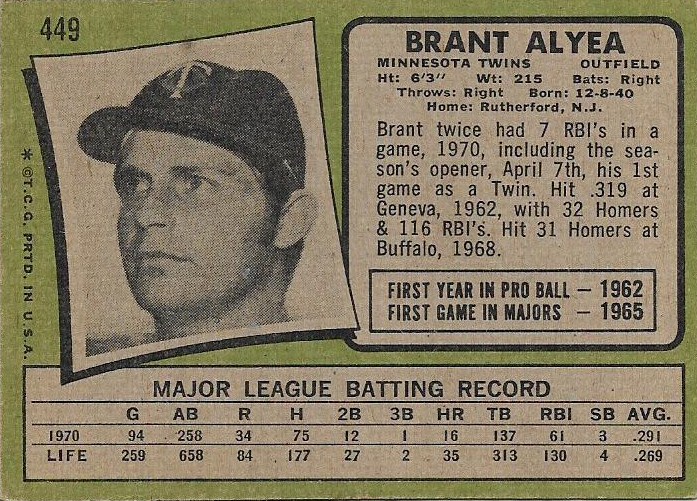
no. 449 - brant alyea
Who is the man: Brant Alyea had completed his best season in the majors when this card arrived. He hit 16 home runs in just 94 games in 1970, his first year with the Twins, who acquired him from the Senators in March of that year.
Can ya dig it: Alyea is posing in Yankee Stadium. You can barely make out the Yankee logo on the scoreboard.
Right on: Alyea's full name is Garrabrant Ryerson Alyea. Good to see he at least got the "R" in the signature.
You see that cat Alyea is a bad mother: Alyea hit a three-run home run in his first major league plate appearance on Sept. 12, 1965.
Shut your mouth: Alyea's son played pro ball in the minor leagues for the Blue Jays, Rangers and Mets organizations in the late 1980s. But Brant wasn't aware that his son, also named Brant, was in pro ball until his son had already been signed and had started playing in Medicine Hat, Alberta, Canada. Alyea's boss at a casino alerted him to the fact.
No one understands him but his woman: Alyea met a woman while playing winter ball in Nicaragua and fathered Brant Jr., not realizing he had a son until returning the country the following year. He then lost touch with his son due to the political turmoil in the country until Brant Jr.'s career was under way.
(A word about the back): Two 7-RBI games in one season is awesome. Aylea hit five home runs and drove in 23 runs in his first 53 games with the Twins in 1970. He made the cover of The Sporting News in May of that year.
Wednesday, April 29, 2015
no. 405 - leo cardenas
Who is the man: Leo Cardenas was entering his third and final season with the Twins in 1971, after playing in 160 games for Minnesota in 1970.
Can ya dig it: That's a very off-center card. I should probably look around for something with a right-hand border.
Right on: This wouldn't be the only time that Cardenas performed the "the fish was this big" pose. He does it on his final card, too.
You see that cat Cardenas is a bad mother: Cardenas was a gold glove shortstop with the Reds in the 1960s and made the All-Star team four times with Cincinnati.
Shut your mouth: This is just the second time that Topps refers to Cardenas by his given name of Leo on his card. For his first 10 cards, Topps called him "Chico" Cardenas.
No one understands him but his woman: Cardenas served three months in jail in 1998 for assault after he broke a co-worker's arm with a bat. Cardenas became irate after spotting his wife sitting in a car having lunch with the co-worker. Cardenas claimed self-defense in the case.
(A word about the back): Cardenas appeared in 160 games in 1969 as well, and led the league by playing in 163 games in 1964.
Thursday, March 19, 2015
no. 391 - twins rookie stars
Who is the man: Steve Brye made his first appearance in a major league game in 1970 while Cotton Nash made his last. Confused? Well you won't be after this edition of ... Twins Rookie Stars.
Can ya dig it: This is the second team to have two rookie stars cards in the 1971 set. The Pirates were the first. Here is the Twins' first.
Right on: I am very distressed right now that a player named Cotton Nash did not become a well-known figure in major league baseball.
You see these rookies are bad mothers: A player named "Cotton" or no, they're rookies and therefore not bad-ass. (Nash got his nickname because of his light blond hair).
Shut your mouth: Steve Brye will forever be known in my mind as the favorite player of my younger brother's stuffed lion. I've mentioned this on three blogs now and it sounds as ridiculous as ever.
No one understands him but his woman: Nash is one of the few to play for both Major League Baseball and in the NBA. Nash also played pro basketball in the old ABA.
(A word about the back): Nash played in parts of the 1967, 1969 and 1970 seasons for the White Sox and Twins, but his pro baseball career ended after a season in the Rangers' organization in 1972.
Thursday, November 13, 2014
no. 349 - rich reese
Who is the man: Rich Reese played in a career-high 153 games in 1970 after a breakout year in 1969 in which he batted .322 for the AL West-winning Minnesota Twins.
Can ya dig it: That's quite the wide stance there.
Right on: It appears that the Twins are playing the Yankees in this photo. I'm wondering if Thurman Munson is the catcher, which would make yet another cameo for the king of early '70s cameos.
You see this cat Reese is a bad mother: Reese is probably most remembered by Twins fans as the man who hit a pinch-hit grand slam in 1969 against the Orioles to win the game for Minnesota and end pitcher Dave McNally's win streak at 17 straight games, which was one short of the AL record.
Shut your mouth: Reese went on to work for Jim Beam after his baseball career and eventually became CEO for the company. He said he gave the name to the vodka drink "Blueberry Muffin".
No one understands him but his woman: Reese was beginning what would be a precipitous decline in 1970. In '71, he'd hit .219 and a couple years later he couldn't get to .200. Reese replaced Harmon Killebrew at first base when Killebrew returned to third in 1968. But the Twins' investment in Reese caused them to term infield prospect Graig Nettles expendable and he was dealt to the Indians. Reese was a part-time player for the Twins by '73.
(A word about the back): Sure, career highs in games, at-bats, runs and stolen bases (woooo -- five!), but Topps neglects to mention that Reese had four fewer hits in 1970 than 1969 despite 82 more at-bats. Fewer doubles, homers, RBIs, etc., too.
Friday, July 25, 2014
no. 313 - tom hall
Who is the man: Tom Hall enjoyed the most productive season of what was then a three-year career in 1970, pitching 41 of his 52 appearances in relief, winning 11 games and posting a 2.55 earned-run average.
Can ya dig it: I see the "Win Twins" logo on Hall's shoulder. I like it.
Right on: Hall appears to be pretending to throw a pitch a long way from the field.
You see this cat Hall is a bad mother: Hall was a key member of Cincinnati's Big Red Machine bullpen between 1972-74, appearing in 143 games and averaging more than seven strikeouts per nine innings.
Shut your mouth: Hall was nicknamed "The Blade" because he was 6-feet and only 150 pounds. You can sort of see that in this photo.
No one understands him but his woman: Hall was overlooked for a photo in the 1977 Topps set. He pitched in 36 games between the Mets and Royals in 1976, and did return to the Royals for the 1977 season. He should have appeared in a Royals uniform in the '77 set.
(A word about the back): The bio write-up is referencing Jim Perry, who led the Twins with 278 1/3 innings in 1970 and struck out 168 batters.
Thursday, May 8, 2014
no. 290 - tony oliva
Who is the man: Tony Oliva really was the man at this point, enjoying one of the finest runs of his career. He would win the American League batting title in 1971 by hitting .337, the best single-season average of his career.
Can ya dig it: Oliva looks remarkably young on this card, and really on most of his cards.
Right on: Love the Twins uniforms from this time period.
You see this cat Oliva is a bad mother: Oliva was the first player to win Rookie of the Year honors and the American League batting title in the same year. In fact, he was the first Cuban player to win rookie of the year or a batting title.
Shut your mouth: Oliva didn't receive a lot of attention despite his ability. And he wasn't one to draw attention to any discrimination. To this day he is often overlooked.
No one understands him but his woman: There was quite a bit of confusion about who Oliva actually was when he was signed by the Twins. To speed his way out of Cuba, he used his brother Pedro's paperwork and arrived at camp known as "Pedro Oliva." It took him a long time to shake the name "Pedro" and he eventually legally changed his name to Pedro Oliva Jr. Quite frankly, while reading up on Oliva, I'm still confused by the circumstances, what actually happened and what his name actually is.
(A word about the back): 1970 would be the last time that Oliva would lead the league in hits.
Wednesday, March 12, 2014
no. 271 - bill zepp
Who is the man: Bill Zepp was a Detroit Tiger by the time this card appeared in packs. He was traded by the Twins in March of 1971.
Can ya dig it: Still love the classic hands-over-head pitching pose, although once again I am sure there is no ball in that glove.
Right on: This is Zepp's only solo card. He appears on a three-player "rookie stars" card in the 1970 Topps set.
You see this cat Zepp is a bad mother: Zepp's major league debut came at Yankee Stadium in the eighth inning on Aug. 12, 1969. He retired Roy White and Bobby Murcer on ground balls and struck out Thurman Munson.
Shut your mouth: Zepp's career was cut short in 1971 by an elbow injury. This was almost four years before Tommy John surgery so Zepp just packed up and called it a career.
No one understands him but his woman: When Zepp was called up to the major leagues for the first time in 1969, it occurred shortly after the incident between Twins manager Billy Martin and pitcher Dave Boswell in which Martin knocked out Boswell. When Zepp arrived with his new team, the first person he saw was Martin. Zepp went up to greet his new manager and Martin put out his left hand and shook Zepp's hand feebly. Only later did Zepp learn why Martin did that.
(A word about the back): When Zepp pitched for the University of Michigan, he was drafted three straight years by the Braves in 1965, Tigers in 1966 and Red Sox in 1967 and did not sign each time. Zepp said he didn't sign because he didn't have a good career at Michigan (winning only six games his whole college career) and didn't have the confidence or desire to perform in the majors then.
Subscribe to:
Posts (Atom)